
Academic program

String Instruments Performance Diploma

The curriculum develops erhu and huqin-family performance through technique, tone production, repertoire, solo work, and ensemble practice.

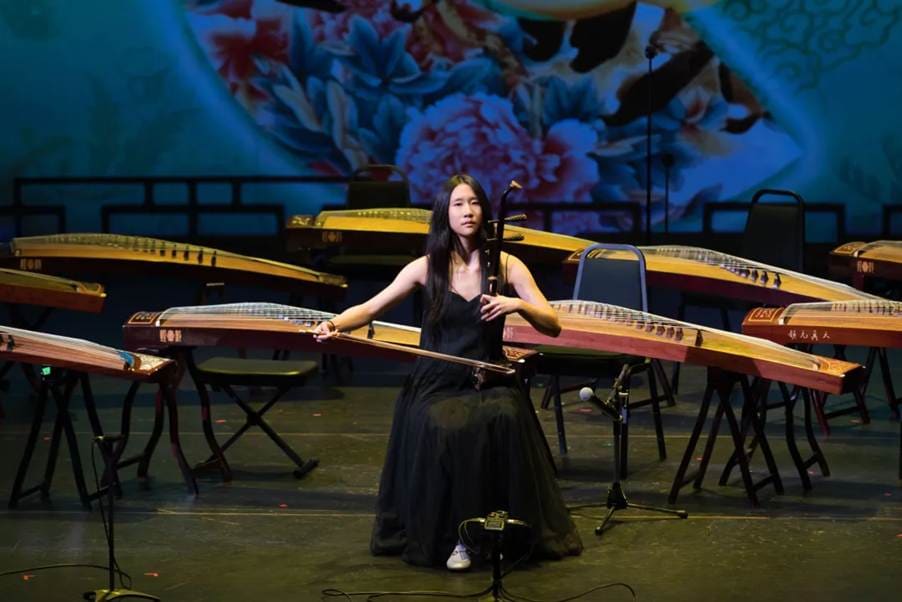
A YCMA student performing an erhu solo on stage

Academic focus

Technique, repertoire, and performance

The program brings disciplined individual practice together with stylistic study, ensemble awareness, and sustained preparation for public performance.

  • Erhu technique and tone production
  • Huqin-family repertoire and musicianship
  • Solo, concerto, and ensemble performance

Learning design

How learning develops

Learning progresses through teacher demonstration, individual guidance, score study, technical exercises, listening, rehearsal, and performance review. Repertoire is used as the setting in which technique and musical judgement develop together.

Program learning outcomes

  • Use balanced posture, coordinated bowing and fingering, secure intonation, and a broad range of articulations.
  • Recognize the ranges, timbres, techniques, and regional styles represented within the huqin family.
  • Interpret traditional and contemporary repertoire with clear phrasing, stylistic awareness, and an individual musical voice.
  • Coordinate with chamber ensembles and conducted orchestras in concerto performance.

Representative repertoire and materials

  • Selected works from Liu Tianhua’s Ten Erhu Pieces
  • Moon Reflected on Second Spring; Horse Racing; Rain on the Banana Leaf
  • The First Erhu Rhapsody; Autumn Rhyme; The Great Wall Capriccio
  • Sunshine over Tashkurgan; The Butterfly Lovers

Curriculum

Curriculum

The four-course sequence develops erhu technique, knowledge of the huqin family, contemporary repertoire, and concerto performance.

Each course entry includes its full description, learning outcomes, repertoire or materials, teaching methods, and the operational details published with the curriculum. Open an individual course or display the complete curriculum at once.

Course information

This advanced erhu program combines one-to-one instruction with intensive solo and ensemble performance experience. The published curriculum consists of four courses, each listed at 480 hours.

Historical version: This information reflects the arrangements in effect when it was published and may have changed. Confirm current admissions, scheduling, assessment, and completion requirements with the academy.

Course sequence

101Basic Skills and Techniques

Studies erhu theory and fundamental technique through Liu Tianhua’s Ten Erhu Pieces and Zigeunerweisen. The course connects posture, tone production, bowing, fingering, scales, modes, musical narration, and the preparation of two complete solo works.

Learning outcomes

  • Understand the fundamentals of erhu.
  • Play with a balanced, elegant, and relaxed posture.
  • Control bow distribution, speed, pressure, and contact point to produce a clear tone.
  • Use left-hand fingering to communicate musical language accurately.
  • Locate pitches accurately.
  • Use détaché, legato, martelé, staccato, and spiccato.
  • Understand the requirements of erhu repertoire and perform works at different expressive depths.
  • Perform major and minor scales and modal patterns.
  • Prepare Liu Tianhua’s Ten Erhu Pieces and Zigeunerweisen to the performance standard stated in the course record.
  • Shape musical narration and communicate emotion and content through the instrument.
  • Prepare two complete erhu works for the end-of-course performance.

Required repertoire and materials

  • Erhu and sheet music
  • The academy provides the required sheet music.

Teaching methods

  • Music-knowledge classes with no more than ten students
  • One-to-one specialist instruction
  • Ensemble classes with more than three students

Course requirements (historical version)

Duration
480 hours
Prerequisite
Pass the YCMA entrance examination.
Assessment
Assignments 60%; final performance of two assigned pieces 40%.
Completion requirement
Passing threshold: 70%.
102The Huqin Family

Studies the theory and traditional repertoire of the huqin family—zhonghu, gaohu, banhu and gehu—through works including Horse Riding on the Prairie, The Beautiful Prairie, Autumn Moon over the Calm Lake, Fishing Boat at Dusk, Chat Between a Couple, Visiting Her Fiancé, Largo, and Without You. Students prepare assigned repertoire on three huqin instruments in addition to erhu.

Learning outcomes

  • Recognize the tuning, range, construction, timbre, and regional intonation of zhonghu, gaohu, banhu, and gehu.
  • Adapt posture, bow distribution, speed, pressure, fingering, and position work to each instrument.
  • Produce secure intonation and tone across low, standard, and high registers.
  • Use détaché, martelé, staccato, slurs, rapid bowing, spiccato, ricochet, sight-reading, and position changes as required by the selected instruments.
  • Read and perform contrasting huqin repertoire at different dynamic levels and in its appropriate regional style.
  • Prepare the assigned works for three huqin instruments other than erhu.
Zhonghu (viola-range huqin)
  • Know the zhonghu’s low D-and-G tuning and the characteristics that distinguish it from erhu.
  • Play with balanced, relaxed posture in the lower register.
  • Develop a clear zhonghu tone through control of bow distribution, speed, and pressure.
  • Coordinate right-hand bowing with left-hand fingering to secure intonation and pitch.
  • Use détaché, martelé, staccato, slurs, rapid bowing, spiccato, and ricochet.
  • Read zhonghu notation and perform with varied dynamics.
  • Sight-read and shift to third position or higher before returning to first position.
  • Prepare Horse Riding on the Prairie and The Beautiful Prairie.
Gaohu (high-pitched huqin)
  • Know the gaohu’s high G-and-D tuning, its distinguishing characteristics, and its southern intonation.
  • Play with a balanced and relaxed posture.
  • Develop a clear gaohu tone through control of bow distribution, speed, and pressure.
  • Move between the high Cantonese position and the standard northern position.
  • Coordinate bow movement and fingering to secure intonation and pitch.
  • Use détaché, martelé, staccato, slurs, rapid bowing, spiccato, and ricochet.
  • Read gaohu notation and perform with varied dynamics.
  • Sight-read and shift to third position or higher before returning to first position.
  • Prepare Autumn Moon over the Calm Lake and Fishing Boat at Dusk.
Banhu (wooden-soundboard huqin)
  • Know the banhu’s high D-and-A tuning, wooden soundboard, distinguishing characteristics, and northwestern intonation.
  • Play with a balanced and relaxed posture.
  • Develop a clear banhu tone through control of bow distribution, speed, and pressure.
  • Coordinate bow movement and fingering to secure intonation and pitch.
  • Use détaché, martelé, staccato, slurs, rapid bowing, spiccato, and ricochet.
  • Read banhu notation and perform with varied dynamics.
  • Sight-read and shift to fourth position or higher before returning to first position.
  • Prepare Chat Between a Couple and Visiting Her Fiancé.
Gehu (cello-range huqin)
  • Know the gehu’s C-G-D-A tuning and its distinguishing construction and range.
  • Play with a balanced and relaxed posture.
  • Develop a clear gehu tone through control of bow distribution, speed, and pressure.
  • Coordinate bow movement and fingering to secure intonation and pitch.
  • Use détaché, martelé, staccato, slurs, rapid bowing, spiccato, and ricochet.
  • Read gehu notation and perform with varied dynamics.
  • Sight-read and shift to fourth position or higher before returning to first position.
  • Prepare Largo and Without You.

Required repertoire and materials

  • Erhu: Moon Reflected on Second Spring; jinghu: Deep Night; banhu: Hua Bangzi; zhonghu: Northwest Capriccio; gaohu: Rain on the Banana Leaf; gehu: Dancing Queen

Teaching methods

  • Lectures with no more than five students
  • One-to-one demonstrations

Course requirements (historical version)

Duration
480 hours
Prerequisite
A mark of 70% or higher in String Instruments 101.
Assessment
Course-end recital 70%; assignments 30%.
Completion requirement
Passing threshold: 70%.
201Contemporary Erhu Works

Studies contemporary erhu works and the styles of composers including Liu Wenjin, Guan Naizhong, Zhao Jiping, Wang Jianmin, and Tan Dun through The First Erhu Rhapsody, The Dream of Jinghua, Autumn Rhyme, Jianghe and Dream, Tianshan Style, and Mengfeng.

Learning outcomes

  • Use scales, studies, and technical exercises to resolve advanced performance demands.
  • Apply advanced left-hand articulation, trills, vibrato, and spiccato with stylistic purpose.
  • Compare the musical languages of Liu Wenjin, Guan Naizhong, Zhao Jiping, Wang Jianmin, Tan Dun, and other modern composers.
  • Understand the stylistic demands of the principal contemporary erhu repertories.
  • Develop mature musicianship and stage presence.
  • Prepare the six named works to the performance standard stated in the published course record.

Required repertoire and materials

  • The First Erhu Rhapsody; The Dream of Jinghua; Autumn Rhyme; Jianghe and Dream; Tianshan Style; Mengfeng

Teaching methods

  • Lectures with no more than five students
  • One-to-one demonstrations

Course requirements (historical version)

Duration
480 hours
Prerequisite
A mark of 70% or higher in String Instruments 102.
Assessment
Assignments 60%; final performance of two assigned pieces 40%.
Completion requirement
Passing threshold: 70%.
202Erhu Concerto

Applies techniques from courses 101, 102, and 201 to transcribed works and large-scale concertos, with emphasis on the requirements of erhu performance with a small ensemble without a conductor and with a large orchestra under a conductor.

Learning outcomes

  • Understand concerto form and sustain a long-range musical structure.
  • Coordinate entrances, transitions, balance, and tempo with piano, chamber ensemble, or orchestra.
  • Apply the complete technical foundation developed in courses 101, 102, and 201.
  • Interpret Paganini Capriccio, Sunshine in Tashkurgan, The Great Wall Capriccio, and The Butterfly Lovers, including music adapted from other traditions.
  • Prepare two concertos: one with a small ensemble and one with a large orchestra.

Required repertoire and materials

  • Course materials provided by the academy

Teaching methods

  • Lectures with no more than five students
  • One-to-one demonstrations

Course requirements (historical version)

Duration
480 hours
Prerequisite
A mark of 70% or higher in String Instruments 201.
Assessment
Assignments 40%; course-end recital 60%.
Completion requirement
Passing threshold: 70%.

Course scheduling and sequence may vary by term. The academy can confirm the current arrangement for each program.

Admissions

Entry requirements and schedules

The admissions team can explain entry requirements, tuition and fees, class schedules, and upcoming intake availability.

Admissions information